Home › Sea Wildlife › Marine Species › Vertebrates › Parrot Fish › Bicolor Parrotfish
Interesting Facts about the Bicolor Parrotfish
[Phylum: Chordata] [Class: Actinopterygii] [Order: Labriformes] [Family: Labridae] [Genus: Cetoscarus]
These reef-dependent tropical species have a broad Indo-Pacific distribution, and a strong association with healthy coral reef habitats.
This page contains information about bicolour parrotfish (Cetoscarus bicolor), including where they are found, what they eat, and how these colourful marine ray-finned fish reproduce.
Bicolour Parrotfish Distribution and Habitats
Most types of parrot fish live near sandy coral reefs, outer reef slopes, and lagoonal reefs in tropical and subtropical oceans.
Cetoscarus bicolor is widespread throughout most of the Indo-Pacific region, especially Indonesia, the Maldives, and the Philippines. But you can also find these two-coloured parrotfish in:
- East Africa, the Indian Ocean islands, and the Red Sea (less common)
- Southern Japan and parts of Micronesia and Melanesia
- The Great Barrier Reef, Coral Sea, and islands of the western Pacific
The adults prefer to live around exposed reef fronts and slopes with strong water movement and high coral cover, typically at depths ranging between three (3) and thirty (30) metres.
Whereas, the juveniles tend to inhabit shallower environments, such as branching coral areas, protected lagoons, and rubble zones, where there's an abundance of shelter.
Bicolor Parrot Fish Characteristics
The deep body shape of most parrotfish species is somewhat elongated and laterally compressed (fusiform). The head is robust, yet blunt, and the skin is covered with large, smooth, fish scales.
The standard vibrant colourings of blues, yellows, purples, and greens can change according to their age, gender, and their social status on any given day.
As juveniles, bicolour parrotfish exhibit a uniform colouration of milky white to pale brown, with a distinct orange stripe or band that spreads over the head and around the eyes.
But wait - there's more:
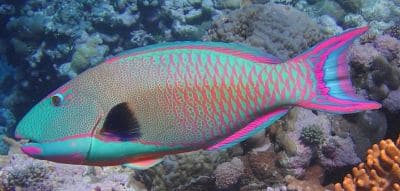
Having transitioned to full maturity, the adults display vivid hues of pale green and blue with pink spots, and thin pink margins that help to accentuate the fin shapes.
Cetoscarus bicolor is one of the largest parrotfish species, and they typically grow up to ninety (90) centimetres long (35 inches).
They secrete a mucus cocoon before they go to sleep (sometimes called a "sleeping bag"). The mucus completely enshrouds their body and helps to reduce predation.
Despite the unmistakable two-tone body pattern and massive parrot-like beak (formed by fused teeth), there is a lack of sexual dichromatism, particularly when compared with other members of the parrotfish family.
What Do Bicolor Parrotfish Eat?
The ecological role of parrotfishes is often overlooked. Yet these herbivorous grazers and scrapers are bioeroders that feed primarily on benthic algae and coral-associated substrates. Hence, they contribute to general reef health as well as sand production.
The diet varies slightly, according to the different kinds of parrot fish. But, bicolor parrot fish are typical herbivores that consume copious amounts of benthic algae (e.g., filamentous algae, turf algae).
 Apart from grazing on algae and coral reef polyps, their daily intake can also include:
- Coral limestone (calcareous material)
- Cyanobacteria
- Detritus matter
- Planktonic organisms
- Seagrass
- Sea sponges
Parrot fish are known for excreting ground-up coral as fine sand. In turn, this type of bioerosion (the removal of calcium carbonate substrate) contributes to the formation of healthy coral reef habitats and soft sandy beaches.
How Do Bicolor Parrotfish Reproduce?
The reproductive strategies of the bicolour parrotfish (Cetoscarus bicolor) are typical of most large reef-dwelling parrotfishes, combining sequential hermaphroditism with spectacular events of broadcast spawning.
As sequential (protogynous) hermaphrodites, all individuals begin their life as females. But later in life, several triggers influence sex changes, especially size and age, and some will transition to males (known as terminal-phase males).
Spawning and Egg Laying
After males and females release their eggs and sperm into the water column, usually at dusk or dawn, fertilisation occurs externally.
For the most part, spawning takes place above the reefs, particularly around the edges of the reef system where water currents help to disperse the eggs.
Here's the thing:
If the water temperature is optimal, the eggs hatch within 24 hours. They immediately become free-floating larvae (pelagic) that drift with planktonic material in the open ocean for several weeks for eventually settling as juveniles onto suitable shallow reef habitats.
Even though growth rates are relatively slow, especially compared to smaller parrotfish species, this type of larval dispersal means bicolor parrotfish can maintain healthy populations across wide geographic areas.
Parrotfish Predators and Anthropogenic Threats
In the wild, Cetoscarus bicolor have many natural predators, especially reef sharks (e.g., the grey reef shark, tiger sharks), moray eels, barracudas, and other large fish species (e.g. groupers and snappers).
Although parrotfish populations are generally healthier in marine reserves and marine parks, some of the human-induced threats that threaten their long-term survival include:
- Climate change (resulting in varying degrees of coral bleaching).
- Illegal fishing practices (e.g. spearfishing) and overfishing.
- Underwater garbage pollution.
- Habitat degradation and destruction (including habitat loss from dynamite fishing).
Pro Tip: In 2009, the IUCN Red List of Threatened Species assessed the status of bicolor parrotfish (Cetoscarus bicolor) as "Least Concern" (LC).