Home › Sea Life › Marine › Vertebrates › Sharks › Catsharks › Small-spotted Catshark
Information about the Small-spotted Catshark
[Phylum: Chordata] [Class: Chondrichthyes] [Subclass: Elasmobranchii] [Order: Carcharhiniformes]
Scyliorhinus canicula is a small, bottom-dwelling, mesopredator shark that fulfills an important role in maintaining balance within benthic marine ecosystems.
The wide distribution and adaptability of the smallspotted catshark has made it one the most common of all shark species found in European waters.
Scyliorhinus canicula Habitat & Distribution
Its common names include the lesser spotted dogfish, sandy dogfish, and the rough hound (morgay) in some regions.
No matter which, they have a well-documented distribution and range of habitats in the northeastern Atlantic and many of the adjacent seas, especially:
- Eastern Atlantic Ocean (Gibraltar, Côte d'Ivoire, Morocco)
- North Sea and Skagerrak (southern Norway, Denmark, British Isles)
- The Mediterranean Sea (Algeria, Croatia, Greece, Italy, Malta, Spain)
The small spotted catshark is a benthic (bottom-dwelling) species that inhabits a variety of seabed types around the continental shelf areas of western Europe.
Despite a typical depth range of ten (10) to one hundred (100) metres, documented research suggests they also thrive at lower depth limits approaching 800 metres, especially in deeper parts of the Mediterranean.
Like most of the catshark species, they prefer to live near sandy and muddy substrates, such as rocky reefs and seagrass beds, where there's an abundance of Mediterranean tapeweed (Posidonia oceanica).
Small-spotted Catshark Characteristics
In general, most smallspotted catsharks can grow up to one metre in total body length and weigh around two (2) kilograms, although some adults are significantly smaller around the coastlines of Europe.
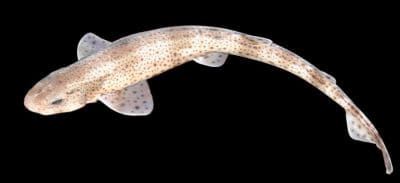
Their body shape is slender and somewhat elongated, with a slightly flattened or blunted head. They have a pale grey or sandy brown skin colour with multiple dark brown or black spots and dermal denticles that create a rough, sandpaper-like texture.
Here's the thing:
Most catsharks have large, ovate eyes with well-developed nictitating membranes that have evolved for living in low-light conditions.
The small, ventrally positioned mouth contains tiny, sharp, and slightly curved teeth, which are ideal for capturing and tearing small prey.
There are two dorsal fins located far back on the body, and the caudal fin is long and narrow with an accentuated upper lobe. The broad pectoral fins are rounded, a key feature for resting in benthic environments.
Small-spotted catsharks possess a highly sensitive sense of smell. This advanced form of olfaction is essential for these nocturnal foragers.
Pro Tip: All catsharks are capable of buccal pumping, a process where they can actively pump water over the gills while they are resting.
What Do Smallspotted Catsharks Eat?
Being an opportunistic benthic predator means the smallspotted catshark (Scyliorhinus canicula) has a diet based on small animals that live on (or near to) the seabed.
 The main components include a combination of:
- Decapod crustaceans (amphipods, hermit crabs, prawns, shrimps)
- Marine mollusks (bivalves, cuttlefish, squids)
- Polychaete worms (including sipunculid worms)
- Small bony fishes (flatfish, gobies)
- Tunicates (salps, sea squirts)
The feeding behaviour of catsharks takes place primarily during the darkness at night. They use their keen sense of smell and electroreception to locate any potential prey that may be hiding in the sediment.
They hunt by grasping and swallowing it, rather than spending too much time and energy tearing it apart. This type of feeding on a broad range of bottom-dwelling organisms helps to regulate excessive populations of ocean invertebrates and small fish.
Scyliorhinus canicula Reproduction and Lifespan
The small-spotted catshark reproduces through a process known as 'oviparity'. This means oviparous females lay eggs rather than giving birth to live young.
Although mating occurs throughout most of the year, there will be peaks in certain months and in certain regions.
During their mating rituals, males use paired reproductive organs (claspers) to transfer their sperm to a female, which often involves some biting of a female's pectoral fin to maintain a stable position.
Egg Laying and Development
After successful fertilisation, the female produces a leathery, rectangular shaped egg case, sometimes called a mermaid's purse, and she attaches it onto a hard substrate, such as corals, rocks, or seagrass. Each egg case contains long tendrils located at the corners.
Thus, these catshark embryos develop outside of the mother's body, which may take up to eleven months before they hatch. They get nourishment from the yolk sac and some protection inside the egg cases.
Hatching
A fully formed juvenile (measuring about 8 centimetres long) hatches from the egg case once the development process is complete. The young catsharks are independent immediately and they will receive no parental care.
Even though their reproductive strategy produces few offspring, the protective egg cases - and well-developed hatchlings at birth - help to increase their survival rates in benthic ecosystems, with a lifespan up to twelve (12) years long.
Sandy Dogfish Predators and Threats
In the wild, small-spotted catsharks (Scyliorhinus canicula) face a number of natural predators, especially:
- Cephalopods (e.g., large octopus)
- Gadidae (predatory codlike fishes)
- Large sharks (e.g., nursehounds and groundfish)
- Marine mammals (seals in particular)
Other human-influenced and anthropogenic threats come from fishing pressures (bycatch in bottom trawls and gillnets), pollution in the ocean (such as chemical pollutants and heavy metals), catshark habitat degradation, commercial consumption, and recreational fisheries - including being kept in large public aquariums.
Important: In 2020, the IUCN Red List of Threatened Species assessed the conservation status of smallspotted Catshark (Scyliorhinus canicula) as "Least Concern" (LC) with a "Stable" population trend.
Related Information and Help Guides
- Deepwater Catshark Facts and Species Information with Pictures
- Fun Facts and Information about Sawsharks (Pristiophoridae)
- Viper Dogfish Characteristics and Behavioural Traits (Etmopteridae)
Note: The short video [2:37 minutes] presented by "Deep Marine Scenes" contains extra small-spotted catshark facts with footage showing where this bottom-dwelling shark species is most abundant.