Home › Sea Life › Marine Species › Vertebrates › Sharks › Blacktip Shark
Interesting Facts about Blacktip Sharks
[Phylum: Chordata] [Class: Chondrichthyes] [Order: Carcharhiniformes] [Genus: Carcharhinus]
Despite a circumglobal distribution, these warm-water coastal species favour shallow, nearshore habitats, with the juveniles being especially dependent on protected coastal nursery areas.
Check out these fun and interesting facts about the blacktip shark (Carcharhinus limbatus), including where these requiem sharks are found, what they eat, and how they reproduce.
Black Tip Sharks Habitat and Global Range
The geographical distribution of Carcharhinus limbatus is far-reaching, especially in tropical and warm-temperate waters, such as:
- Central Pacific Islands (the Galápagos, Hawaii, and the Marquesas)
- Eastern Atlantic (the Mediterranean Sea, West African coast, Angola)
- Indo-West Pacific (the Red Sea, East Africa, Southeast Asia, northern Australia, and the western Pacific islands)
- Western Atlantic (northeastern United States, the Gulf of Mexico, the Caribbean Sea, southern Brazil)
The populations fluctuate between regional residence and seasonal migratory patterns, usually shifting closer to the poles during the warmer months and the equator during coolest periods.
Because blacktip sharks are primarily a coastal and continental shelf species with habitat preferences for shallow waters, they are mostly seen near the surface and down to depths of thirty (30) metres.
The nearshore environments that create ideal settings for this particular species of shark are muddy bays, sandy beaches, surf zones, river estuaries, and island lagoons.
Here's the thing:
Despite not being true freshwater sharks, they have developed a tolerance for wide-ranging water salinities, and they are regularly found in brackish water.
As juveniles, they spend most time around nursery areas, such as estuaries and coastal embayments. The relative safety of these shallow, protected habitats provide young blacktip sharks with some protection against predation.
Blacktip Shark Characteristics and Behaviour
A combination of morphological, behavioural, and ecological traits help to define the blacktip shark (Carcharhinus limbatus) and distinguish it from other species of requiem sharks.
They are a medium-sized shark, with fully grown adults typically reaching a total length between 1.5 and two (2) metres (6 feet).
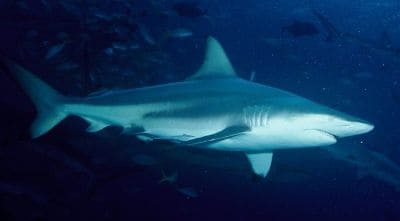
The slender and streamlined body form, gray to bronze coloured dorsally with a white ventral surface, is specially adapted for fast swimming.
But wait - there's more:
As their common name suggests, they have distinctive black tips on most fins, particularly the dorsal, pectoral, pelvic, and lower lobe of the caudal fins.
Blacktip sharks have a long, pointed snout, and their eyes are large with a nictitating membrane (inner eyelid).
Their teeth are narrow, triangular shaped, and serrated (especially the upper teeth) for cutting up their favourite prey - teleost fish species.
These highly agile, fast swimmers are capable of rapid acceleration. Yet, the breaching behaviour of spinning and leaping out of the water to feed on schooling fish is one of their most notable characteristics.
What Do Blacktip Sharks Eat?
Apart from the streamlined build and distinctive fin markings, the blacktip shark species is better known for their fast and active hunting style in warm-water, shallow, coastal environments.
These mid-level predators are active, diurnal, opportunistic carnivores with a diet dominated by small or medium-sized, fast-moving prey.
 Their primary diet includes bony fishes (teleost), including:
- Anchovies
- Clupeids (e.g. herrings)
- Jacks
- Menhaden
- Mullet
- Sardines
- Scads
In addition, a secondary consumption often includes cephalopods (e.g., cuttlefish, squids) and ocean crustaceans, especially crabs and shrimps.
The feeding behaviour of black tip sharks usually occurs in the mid water column and close to the surface. These piscivorous predators are also known to hunt in groups to improve capture efficiency.
How Do Blacktip Sharks Reproduce?
Most requiem sharks reproduce via a viviparous, placental reproductive strategy. Hence, reproduction in blacktip sharks is sexual with internal fertilisation.
In general, mating occurs in late spring to early summer. Males use modified pelvic fins (also known as claspers) to transfer their sperm to the females. As a consequence, both courtship and mating can be physically forceful, and it often leaves females with bite marks.
Gestation and Development
After the gestation period and initial yolk-based development, which typically lasts around 12 months, the embryo forms a placental connection with the mother.
The placenta allows for direct nutrient and gas exchange. It's a process that supports more advanced development when compared with other egg-laying sharks.
Litter size can vary between two (2) and ten (10) pups, and each pup will be around sixty (60) centimetres long at birth. Blacktips use nursery habitats that are warm, shallow, and protected. The young usually stay in the nursery areas for several months before they eventually move offshore.
Blacktip Shark Predators and Threats
Despite a moderate growth rate and lifespan that may last up to fifteen (15) years, Carcharhinus limbatus are mid-level hunters that also face a number of natural predators and human-induced threats.
The juveniles are preyed upon by larger sharks, especially bull sharks (Carcharhinus leucas) and tiger sharks (Galeocerdo cuvier).
Predation in adults occurs mostly through great hammerheads, tiger sharks, and killer whales (orcas) in certain regions.
Even so, the primary drivers of mortality in blacktip sharks worldwide are human-related behaviours, including:
- Commercial and artisanal fisheries targeting them directly for their meat and fins.
- Bycatch in gillnets, longlines, and trawls, as well as recreational fishing practices.
- Pollution in the ocean results in a bioaccumulation of heavy metals and organic pollutants, with some documentation showing plastic ingestion.
- Blacktip shark habitat degradation (especially the nursery habitats in some estuaries, mangroves, and coastal lagoons).
Important: In 2020, the IUCN Red List of Threatened Species assessed the conservation status of blacktip shark (Carcharhinus limbatus) as "Vulnerable" (VU) with a "Decreasing" population trend.