Home › Ocean › Marine Life › Invertebrates › Mollusks › Sea Snails › Cowry
Fun and Interesting Facts about Cowries
[Cowry Phylum: Mollusca] [Class: Gastropoda] [Order: Littorinimorpha] [Family: Cypraeidae]
The smooth or glossy domed shell with its long and narrow slit (called an aperture) is the main reason why these marine mollusks are popular with collectors of sea shells.
This section contains a collection of little-known facts about cowries (family Cypraeidae), including where they are found, what they eat, and how these marine gastropod sea snails reproduce.
Cowry Shells Habitat and Geographic Range
In spite of their wide ranging distribution, cowries are most frequently seen in tropical and subtropical oceans.
The highest diversity of cowrie shell species occurs in the Indo-Pacific region, as well as:
- Australia (especially Queensland and Western Australia)
- East African coast (e.g., Kenya, Mozambique, and Zanzibar)
- Pacific Islands (e.g. Fiji, Micronesia, Hawaii, and Polynesia)
- Southeast Asia (including Thailand, Philippines, Malaysia, Vietnam)
Cowrie snails are typical of most marine gastropods in that they occupy a broad scope of niches as habitats. Even so, most of them flourish around coral reef formations and even some artificial reefs, such as sunken shipwrecks and at some of the new 3D printed coral reefs.
In general, the cowrie snail species prefer marine environments and subtidal habitats with soft sandy bottoms. So, it's quite common to see the shells partly buried in oceanic silt and substrate.
Interesting Fact: Different kinds of cowries can handle a broad spectrum of depth ranges, such as shallow tidal pools (only a few metres deep) and depths over hundred metres, but there are no living cowries in any freshwater environments.
Cowrie Shell Characteristics
The general shape and size of each cowry varies according to the species, of which there are around two hundred and fifty (250) known examples.
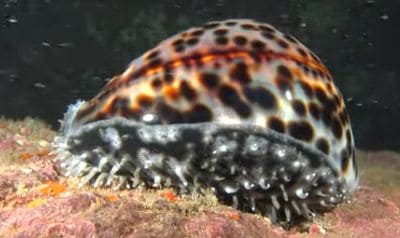
A good way to describe the actual surface of these highly polished shells is ovate (e.g. domed). The top is smooth and rounded with a flattish underside. There are fine teeth on each side of the long narrow opening (aperture).
Compared with most of the small non-poisonous sea snails, the mantle cover in cowries tends to be more colourful with bolder patterns.
Key points...
The sea snail body parts share some similarities with this classification. But, a cowry's shell is naturally glossy and shiny (polished) because the mantle extends over it and the snail constantly maintains it.
Shell colours and patterns are diverse, often with a combination of bands, blotches, spots, and marbling. Some of the common colours are red, pale brown, cream, white, and yellow.
Even though most cowry species are nocturnal, and they stay hidden for most of the day, they use their muscular foot to crawl around when they feed at night.
 Cowrie Shell Size
The chich-pea cowrie (Pustularia cicercula) is considered as being one of the smallest, and it rarely grows more than one (1) centimetre in overall length.
By comparison, the tiger cowrie (Cypraea tigris) is one of the largest in the species. Adults can measure up to twenty (20) centimetres long (8 inches).
What Do Cowry Snails Eat?
Like many other nocturnal feeders, cowries also emerge during the darkness to feed when there are fewer active predators around.
Many of them use their rasping tongue (called a radula) to scrape surface films on rocks and graze on other soft materials, such as:
- Algae (and biofilm)
- Decaying organic matter (detritus)
- Encrusting invertebrates (e.g., bryozoans, tunicate sea squirts)
- Sea sponges (Porifera)
- Soft coral heads and polyps
Fun Fact: Even though most cowries are herbivores, some of the carnivorous or omnivorous species include the chestnut cowrie and the tiger cowrie.
Types of Cowrie Snail Species
Arabian Cowry (Mauritia arabica)
A high diversity of cowrie snails are found across the Indo-Pacific regions, including the Arabian Peninsula, East Africa (especially Madagascar), Japan, Australia, and eastern Polynesia.
With this particular cowrie shell species, the marine mollusk that lives in a cowrie seashell thrives better near coral reef habitats and rocky substrates, most often at depths shallower than ten (10) metres.
Appearance and Size
The oval shaped shell is domed dorsally, but the grey ventral side (underside) is actually quite flat. While it is a living cowrie, the mantle envelops the shell and produces a highly effulgent surface (extremely glossy and polished).
In adults, the shell length is rarely much longer than eight (8) centimetres. But a network of darker spots or blotches, almost mesh patterned, combines with the light brown background.
Diet and Reproduction
Arabian cowries generally hide during the daytime to avoid predation. But, these omnivores become more active when darkness arrives, grazing on algae, sea sponges, and detritus.
Females lay large clusters of eggs and then they guard them until they hatch. The larvae go through the free-swimming planktonic stage before they settle on the ocean floor.
Atlantic Deer Cowry (Macrocypraea cervus)
Macrocypraea cervus (formerly Cypraea cervus and commonly called the giant Atlantic cowrie) is one of the largest and most distinctive of all cowries.
This particular cowry snail is found in many parts of the tropical and subtropical western Atlantic, especially the Caribbean coasts of Central America, Bermuda, Florida, Bahamas, and northern South America (e.g., Colombia, Venezuela).
Like most types of cowrie shells, they inhabit shallow to moderately deep reef environments where there's some kind of hard-bottom substrates. They live underneath coral ledges and within crevices of most rubble zones at depths ranging between three (3) and thirty (30) metres below sea level.
Description and Size
As adults, Atlantic deer cowries commonly grow to ten (10) centimetres in overall body length. The robust shell is smooth and polished (glossy), but the mantle is fleshy and patterned (when fully extended).
The base is a light brown tan colour with a scattering of pale or whitish spots. The darker coloured margin has rows of fine teeth at the aperture.
Feeding and Reproduction
Most of the cowry shell species are nocturnal grazers that tend to stay concealed out of sight for most of the daylight hours. The diet mainly consists of sea sponges (family Spongiidae), algae, and biofilm.
The reproductive strategy involves egg masses brooded by females. After the free-swimming, planktonic stage in the development of marine snails, the veliger larvae eventually develop into benthic juveniles.
Although they're not officially classified as critically endangered or threatened, Macrocypraea cervus is a low density species that is vulnerable to habitat degradation in coral reef systems and collection for use as decorative objects in shellwork.
Calf Cowrie Shell (Cypraea vitellus)
Chestnut Cowrie (Neobernaya spadicea)
Chick-pea Cowrie (Pustularia cicercula)
Cribrate Cowrie (Cypraea cribellum)
Dirty Cowry (Naria spurca)
Dotted Cowrie (Cypraea punctata)
Eglantine Cowrie (Cypraea eglantina)
European Cowrie (Trivia monacha)
Gaskoin's cowrie (Cypraea gaskoini)
Harlequin Cowrie (Cypraea histrio)
Humpback Cowrie (Cypraea caurica)
Isabella Cowrie (Cypraea isabella)
Lynx Cowrie (Cypraea lynx)
Map Cowrie (Cypraea mappa)
Mole Cowrie (Cypraea talpa)
Money Cowrie (Cypraea moneta)
Mourning Cowrie (Cypraea mauritiana)
Panther Cowrie (Cypraea pantherina)
Porcelain Cowrie (Cypraea poraria)
Ring Cowrie (Cypraea annulus)
Serpent's-head Cowrie (Cypraea caputserpentis)
Tiger Cowrie (Cypraea tigris)
Wanderer Cowrie (Cypraea errones)
How Do Cowrie Shells Reproduce?
Cypraeidae cowry snails share many of the basic reproductive strategies used by marine gastropod snails - albeit with a few different features.
Reproduction in cowrie shells occurs through "dioecism", a process where males and females have their individual reproductive organs.
Fertilisation takes place when a male transfers his sperm directly to a female via a modified organ. So unlike many marine invertebrates, they do not release gametes into the water.
Then...
Following a successful fertilisation, the female cowry lays her gelatinous capsules full of eggs and attaches them to solid structures, like coral, rocks, or discarded fragments of animal shells. There might be several hundred cowrie eggs in each capsule.
The larvae of some species develop as veligers (free-swimming planktonic larvae) that drift aimlessly in the ocean for several weeks before they eventually find a suitable place in the substrate to settle and grow into adults.
Cowrie Predators and Threats
In the wild, cowrie lifespan is around ten years in many species, but some of the largest can live for up to twenty (20) years.
Even though the shells exhibit a tough appearance, cowries face a number of natural predators, and a few human-driven existential threats as well.
Some of the natural predators of cowrie shell snails include:
- Fish families (especially pufferfishes, triggerfishes, and wrasses)
- Crabs
- Mollusks (such as cone shell snails and octopuses)
Some humans also collect cowry snails for shell craft. Other contributing factors for a decline in a few vulnerable areas include certain types of human behaviour (e.g., ocean acidification, coral reef destruction and degradation, overharvesting, and ocean pollution).
Important: The IUCN Red List of Threatened Species is a comprehensive source of information about the global conservation status of animals, fungi, and plants. Research suggests that some cowrie shells are suffering from regional endangered status, such as in parts of Polynesia and Singapore.
Diver Tips for Spotting Cowrie Shells
Because cowries are largely nocturnal, night dives are often the best times to see them. Use underwater flashlights to look along the underside of ledges and inside coral rubble.
Divers who flip over rocks, move coral slabs, or disturb sea sponges can damage the habitat and harm any marine life hiding underneath. Instead, use your light to inspect gaps without disturbing the structure when you scan naturally exposed surfaces.
Here's the thing:
Cowries will be stressed even from brief handlings. This causes them to retract abruptly, or it may expose them to their predators. To see a cowrie mantle, stay still and be patient because some cowries will emerge on their own if they don't feel threatened.
Even though they are both marine gastropods, and the venomous cone snail is poisonous, cowrie snails are not poisonous and they don't have any poisonous darts. This is why some aquarists keep them as part of a fish keeping hobby to help control algae growth in fish tanks.
Related Information and Help Guides
- Sea Snail Anatomy and Body Parts with Labelled Diagram
- Cone Snail Facts and Species Information with Pictures
- Interesting Facts about Flamingo Tongue Snails (false cowries)
Note: The short video [3:35 minutes] presented by 'Deep Marine Scenes' contains more cowrie facts with fascinating footage of these effulgent shelled marine snails.