Home › Sea Life › Marine › Vertebrates › Sea Bream › Musselcracker
Facts about Black Musselcracker Fish
[Phylum: Chordata] [Class: Actinopterygii] [Order: Acanthuriformes] [Family: Sparidae (seabreams)]
The musselcracker seabream (also called poenskop fish) is a large, slow-growing South African reef fish known for its powerful shell-crushing jaws and vulnerability to overfishing.
Check out these fascinating facts about the black musselcracker (Cymatoceps nasutus), including where they live, what they eat, and how they reproduce.
Musselcracker Fish Habitat and Distribution
The genus Cymatoceps is a large sea bream fish found only in the cool waters of southern Africa.
They are most common along the south and southeast coasts of South Africa.
However, the geographic range stretches from southern Angola to the Namibian coastlines, around the Cape of Good Hope, and eastward to KwaZulu-Natal.
Musselcrackers thrive best in shallow, high-energy coastal zones with plenty of rocky reefs, boulder fields, and underwater pinnacles.
The adults are prone to diving deeper, but the general depth range varies between five (5) and one hundred (100) metres.
Whereas, juveniles tend to hang out closer to the shoreline and rocky gullies searching for invertebrates, especially bivalve mollusks (wild clams, mussels, and oysters).
Black Musselcracker Characteristics
The overall appearance of Cymatoceps nasutus is one of a large, deep-bodied sea bream, with an enormous head and sloping forehead.
Other distinctive features that contribute to the "rugged" appearance are the powerful jaw structure and thick-set lips.
There's no significant patterning, but the body colouring is largely dark grey (almost black) and they have large, coarse, fish scales.
Here's the thing:
The black musselcracker ranks among the largest of all seabream species caught by fisherfolk in southern Africa.
For example, published maximum lengths of 150 centimetres (almost 60 inches), with recorded weights over thirty (30) kilograms are commonplace.
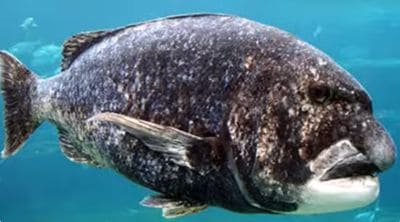 Although the adults tend to live a solitary lifestyle, they are extremely slow-growing and long-lived.
These rare factors have led to a general vulnerability and a popularity for being spearfished for sport, and overfished for culinary fish food.
What Do Black Musselcrackers Eat?
It's fair to say black musselcracker (Cymatoceps nasutus) is the unmistakable durophagous predator.
Their strong jaws and powerful dentition (crushing molar-like teeth) are built for cracking armored molluscs with hard shells.
Besides crabs and mussels, the primary diet of these shell-crushing specialists also includes limpets, periwinkles, sea urchins, and whelks.
Interesting Facts: Along with its smaller close relative, the white musselcracker (Sparodon durbanensis), the ecological roles of these top invertebrate predators around rocky reefs helps to maintain a healthy balance in reef invertebrate populations.
Reproduction in Musselcracker Fish Species
Not only do they mature later than most fast-growing reef fish (often after several years), they also produce fewer eggs. As a consequence of that, their populations are slow to recover from some of the localised fishing pressures.
Scientists believe that "dispersed" spawning events take place offshore, most likely during the warmest months in southern Africa (late spring to summer).
But wait - there's more:
They produce only a few eggs, but they are large and pelagic, so they drift with plankton in open water until they hatch and develop offshore. This is a typical reproductive strategy for long-lived predatory reef fishes.
Juveniles will eventually settle to spend their early years in very shallow rocky gullies and tide-influenced zones. As they grow bigger, they will gradually move offshore into deeper rocky, reef-type habitats.
Musselcracker Predators and Threats
Natural predation in adults is almost non-existent, due to their colossal size and heavy armour of thick scales. But, the juveniles are vulnerable during the development stage. The main predators include:
However, some human-related threats have a much bigger impact on their long term survival rates, especially:
- Bycatch in line fisheries: They may not be the primary target, but they are frequently taken "incidentally" by some shore-based and boat-based anglers.
- Climate-related changes: Shifts in coastal conditions, and particularly water temperatures, could be influencing their geographic distribution.
- Musselcracker habitat degradation: Coastal development, pollution in the ocean, and sedimentation, has some effect on juvenile nursery areas that exist in shallow rocky shore zones.
- Overfishing: Unsustainable fishing and overharvesting are by far the biggest threat to black musselcrackers, primarily because of their slow growth rates and late maturity.
- Spearfishing: Musselcrackers are predictable targets for spearfishers because the adults are large, solitary, and usually attached to specific sites.
Important: The most recent assessment conducted by the IUCN Red List of Threatened Species took place in 2024. The black musselcracker fish (Cymatoceps nasutus) is listed as "Vulnerable" with their current population trend classed as "Increasing".