Home › Ocean Life › Marine Species › Vertebrates › Gunnel
Interesting Facts about Gunnels
[Gunnels Phylum: Chordata] [Class: Actinopterygii] [Order: Perciformes] [Suborder: Zoarcoidei]
About fifteen (15) different species of gunnel fish are still in existence today. These cold-water, coastal fishes have adapted to life in the rocky habitats of intertidal and shallow subtidal zones.
This section contains facts and information about gunnels (family Pholidae), including where they live, what they eat, and how these eel-like marine fish reproduce.
Gunnel Fish Habitat and Geographic Range
The circumboreal distribution of gunnels is closely associated with the cold and cool temperate waters of rocky coastal environments.
They are commonly found in the Northern Hemisphere, especially in:
- North Atlantic Ocean (Arctic Canada, northeastern United States, and subarctic Europe, including the British Isles, Iceland, and Scandinavia)
- North Pacific Ocean (Alaska, Sea of Japan, Sea of Okhotsk, and parts of California)
Gunnels are benthic, eel-like marine fishes that inhabit shallow marine environments - typically at depths between the surface and two hundred (200) metres (656 feet).
They prefer to live around substrates where there is an abundance of rocky reefs, boulder fields, crevices, cracks, or kelp beds.
They also need cold, well-oxygenated water with some exposure to tidal fluctuations. However, an adaptation to cutaneous respiration means they can also tolerate brief exposure to air, such as during low tide.
Gunnels Characteristics and Size
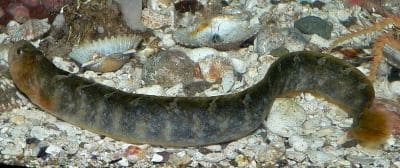
Most of the gunnel species are small to medium-sized coastal fishes. The elongate body, a significant reduction in fins, and scaleless skin are all anatomical features that help to support their cryptic and sedentary lifestyle on the ocean floor.
Plus, the slender and eel-like laterally compressed body shape is particularly suited for making maneuvers through crevices and underneath rocks.
Although the skin is mostly scaleless, or with scale reduction, the skin is covered with a thick mucus that assists cutaneous respiration and helps them avoid predation.
But wait - there's more:
The long and continuous dorsal fin extends almost to the tail from behind the head and it is composed entirely of spines. Most species have a short anal fin and a small, rounded caudal fin - but they lack any notable pelvic fins.
Even though the head is small, with a somewhat blunted profile, the eyes are small for a fish this size. Still, their fine teeth are especially adapted for capturing small invertebrates.
In general, the body colouring is brown and olive, usually marked with some mottling, vertical bars, or spots. It's the ideal camouflage pattern for hiding near filamentous algae and rocks.
Gunnel Fish Size
As adults, gunnels typically grow up to twenty five (25) centimetres long (between 6 and 10 inches) with a body diameter of a few centimetres.
However, the penpoint gunnel can reach lengths up to 45 centimetres (18 inches), and the lesser gunnel (Pholis nea) rarely grows longer than seven (7) centimetres (3 inches).
Interesting Fact: The physical characteristics of gunnels fish reflects a specialisation for occupying tight and structurally complex habitats. They avoid most predators through a combination of concealment and camouflage - rather than speed.
What Do Gunnel Fish Eat?
Being nocturnal means they are most active during the night. Even so, high tide often triggers a feeding frenzy for gunnels.
Their carnivorous diet consists mostly of small benthic invertebrates, especially:
- Bivalves
 Brittle stars
- Crabs
- Echinoderms
- Fish eggs
- Marine mollusks
- Ocean crustaceans
- Segmented worms
In ecological terms, the gunnel fish species occupy a lower trophic level in rocky intertidal and shallow subtidal food webs.
They link small invertebrate populations to higher-level predators, including larger fishes, marine mammals, and seabirds.
Types of Gunnels Species
Banded Gunnel (Pholis fasciata)
Despite being closely related to blennies and pricklebacks (often called shannies), these elongate, eel-like fishes belong in the gunnel family. Hence, they are not true eels.
A physical description of these bony fish reveals a long, slender, and laterally compressed body form. Still, even as adults, the banded gunnel rarely grows longer than thirty (30) centimetres (12 inches).
The key distinctive features are the alternating dark and light vertical bands that run along the body (thus its common name). Nonetheless, this colour intensity varies with age, stress levels, and habitat.
Distribution and Habitat
Pholis fasciata has a geographical range that stretches across most of the North Atlantic Ocean, including the Western Atlantic (e.g., Southern Labrador, New Jersey) and the Eastern Atlantic, especially the British Isles, Western Greenland, and other parts of Scandinavia.
Banded gunnels prefer to inhabit the shallow coastal waters and tide pools of intertidal and benthic zones, typically at depths ranging between sea level and fifty (50) metres.
The primary diet of these opportunistic carnivores includes small crustaceans (especially amphipods and isopods), polychaete worms, and mollusks.
Ecological and Scientific Importance
Their sensitivity to pollution and habitat disturbance means gunnels are an important indicator species as to the overall health of intertidal habitats. In addition, they are frequently studied in research on thermal tolerance and intertidal survival strategies.
Pro Tip: Even though there are about 15 different kinds of gunnels, the banded gunnel scientific name Pholis fasciata is the only one that can tolerate the cold, shallow waters of the Arctic Ocean (as low as 5° Celsius)
Blackeye Gunnel (Apodichthys fucorum)
Crescent Gunnel (Pholis laeta)
Kelp Gunnel (Rhodymenichthys dolichogaster)
Lesser Gunnel (Pholis nea)
Longbelly Gunnel (Pholis dolichogaster)
Penpoint Gunnel (Apodichthys flavidus)
Pricklebacks (Stichaeidae)
Radiated Gunnel (Ulvaria subbifurcata)
Rock Gunnel (Pholis gunnellus)
Rockweed Gunnel (Xererpes fucorum)
Saddleback Gunnel (Pholis ornata)
Thickspine Gunnel (Pholis crassispina)
Tidepool Gunnel (Pholis nebulosa)
How Do Gunnels Reproduce?
The reproductive strategies of numerous cold-water coastal fishes, such as sculpins (Cottoidea), reproduce through sexual reproduction with external fertilisation. The same is true for members of the Pholidae family.
Spawning and egg-laying usually occurs towards the end of the year and into winter time, with some variations by species and geographic latitude. The triggers are colder water temperatures and seasonal photoperiod changes.
Females lay their clumps of sticky eggs underneath stones, inside rock crevices, and scattered with algal blooms.
Gunnels reproduce by laying adhesive eggs in protected benthic sites, often with male parental care, followed by a planktonic larval phase before juveniles recruit to rocky coastal habitats.
Gunnel Predators and Threats
A combination of natural predation and anthropogenic threats tend to be typical for small, benthic coastal fishes. Most of the danger for gunnel fish comes from large, demersal fishes, including:
- Cods (Gadidae)
- Greenlings (Hexagrammidae)
- Sculpins
Living in shallow coastal zones means they also fall prey to some marine mammals (e.g., dolphins) and seabirds, especially cormorants, gulls, and puffins.
The contributing factors for a decline in some vulnerable regions include certain types of human behaviour, such as coral reef destruction and degradation, non-targeted bycatch in shrimp trawls, pollution in the ocean, and warming seas.
Gunnel Facts: The IUCN Red List of Threatened Species assessed most of the gunnel fish species (Zoarcoidei) as "Least Concern" (LC).
Related Information and Help Guides
- Blenny Fish Facts and Species Information with Pictures
- Fish Spine Injury Symptoms and First Aid Treatment
- Weever Fish Facts (Information about Weever Sting Poison)
Note: The short video [2:27 minutes] presented by 'Deep Marine Scenes' contains even more gunnel fish facts with detailed footage of the penpoint gunnel (Apodichthys flavidus).