Home › Ocean Life › Marine › Vertebrates › Cardinal Fishes › Banggai Cardinalfish
Interesting Facts about Banggai Cardinalfish
[Phylum: Chordata] [Class: Actinopterygii] [Order: Gobiiformes] [Family: Apogonidae]
This reef-associated species is native to the far eastern end of Central Sulawesi, where it inhabits shallow seagrass beds and coral reef structures near the sheltered coastal zones.
Here's a collection of fun facts about the Banggai cardinalfish (family Apogonidae), including where they are found, what they eat, and how these small tropical cardinalfish reproduce.
Natural Distribution of Banggai Cardinalfish
The narrow natural range of these particular cardinal fishes is endemic to the Banggai Archipelago in central Indonesia.
It is a region that covers a little over five thousand square kilometres.
In fact, the restricted range and collection pressures for the aquarium industry, have led to population declines in localised areas.
Here's the thing:
Banggai cardinalfish thrive better in shallow, protected coastal areas, usually less than six (6) metres deep.
The typical microhabitats that suit the size and behaviours of these marine fish are seagrass beds (e.g., Enhalus acoroides), lagoons, different types of coral reefs, and ecosystems where there are long-spined sea urchins and branching corals.
Their reliance on these structures, such as for shelter and for developing small, site-attached groups, should not be understated.
Interesting Fact: Due to the ornamental fishkeeping trade, some non-native populations have been 'introduced' in parts of North Sulawesi (Lembeh Strait) and a number of other localities throughout Indonesia.
Banggai Cardinalfish Characteristics
The silver coloured body contains three bold vertical black bars and multiple white spots. The fins are pointed and elongated, especially the dorsal and caudal fins.
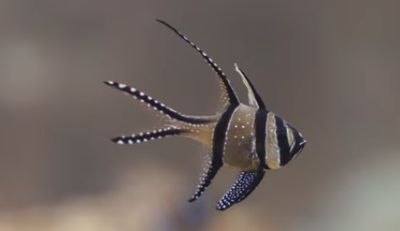 Despite a relatively large mouth and eyes, the body size of the adults is quite small, typically eight (8) centimetres long.
Like the social behaviour of most cardinal fish, they are known for forming small, site-attached groups, usually hovering close to protective structures.
What Do Banggai Cardinalfish Eat?
In the wild, these opportunistic micropredators feed primarily on small, planktonic organisms.
Their diet usually includes copepods, amphipods, juvenile shrimps, small polychaete worms (annelid), fish eggs, and zooplankton.
When kept in captivity, most cardinalfish will accept enriched brine shrimp, mysis shrimp, finely chopped marine foods, and high-quality micro-pellets.
How Do Cardinal Fish Reproduce?
In fact, oviparous reproduction in fishes is commonplace, and parental care is mostly praiseworthy for cardinal fish families. Even so, the males have been known to eat the eggs, often by accident during the courtship ritual.
Internal fertilisation takes place through 'palpitating' movements. This tends to be a weak nuptial dance performed between the fins of the mating partners.
In case you were wondering...
Typically, at least three (3) females will accompany one male in advance of the spawning event. The outcome can turn out to be batches of up to 20,000 eggs.
Male cardinalfish keep the eggs inside its mouth until they hatch. So, until the male expels the eggs, around eight (8) days later, it does not eat any food.
Banggai Cardinalfish Predators and Threats
They face natural predation from groupers, lionfish, and snappers. Juveniles are especially vulnerable when they leave the shelter of sea urchin spines or coral branches.
Yet, far more significant are some human-driven threats, including:
- Intensive collection for the aquarium trade.
- Loss of seagrass and coral habitat.
- Climate-related reef degradation.
- Declines in long-spined sea urchins that serve as key nursery structures.
These pressures place a species with an already restricted range at heightened risk of population collapse in some local regions.
Important: A 2007 assessment released by the IUCN Red List of Threatened Species shows that the conservation status of Banggai cardinalfish species is "Endangered" (EN) with a "Decreasing" population trend.
Related Information and Help Guides
- Funny Fish Names Used by Marine Biologists
- List of Popular Aquarium Fish Kept in Small Tanks
- Marine Biology Vocabulary Listed from A to Z
Pro Tip: The short video [2:21 minutes] presented by 'Deep Marine Scenes' contains even more fun facts about Banggai cardinalfish (Pterapogon kauderni).