Home › Ocean Life › Marine Species › Vertebrate › Blennies › Tube Blennies
Interesting Facts about Tube Blenny Fish
[Phylum: Chordata] [Class: Actinopterygii] [Order: Blenniiformes] [Family: Chaenopsidae]
The order Blenniiformes contains several groups of percomorph marine fish in the blennioid family Chaenopsidae, such as flagblennies, pike-blennies, and tube-blennies.
This segment contains a collection of fun facts about tube blennies, including where they live, what they eat, and how these tube-dwelling fish reproduce.
Tube Blennies Habitat and Range Worldwide
There are about 91 species of tube blenny fish, and most of these tiny tube-dwellers are found in tropical and subtropical marine ecosystems.
They inhabit the shallow eastern Pacific coastlines of Central America, South America, and Mexico (as well as Japan, Korea, and Taiwan).
But, they are more common in the western Atlantic Ocean, especially:
- The Caribbean Sea
- Central and South America
- The Gulf of Mexico
Their typical habitats are coral reef networks and rocky outcrops. The funny fish names often relate to the homes that they occupy, like discarded mollusk shells (especially empty clam shells), unoccupied shells of barnacles, and even the abandoned tubes of polychaete worms.
Some tube-blenny fish species set up microhabitats and live inside small holes or marine debris that exists around sand or muddy areas, such as glass bottles, jars, metal cans, and shell hash.
Nevertheless, they generally thrive better in extremely shallow water, at depths ranging between the surface and twenty (20) metres (65 feet).
Tube Blenny Characteristics
The distinct characteristics of tube-blennies (Chaenopsidae) help to differentiate them from other kinds of blennies and similar sized reef fishes.
For example, the body shape is slender and somewhat elongated (eel-like), typically less than ten (10) centimetres long (between 1 and 4 inches).
They have a large head, and their bulging eyes are located high up on top of the head. Some of the common tube blenny species also have tiny fleshy tentacles (called 'cirri') to help with camouflage and for sensing movement.
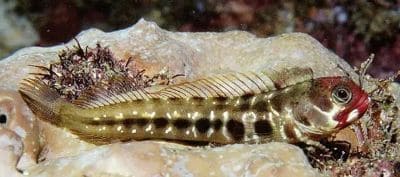 Having an upturned mouth is ideal for snapping at plankton as it drifts overhead.
Another common feature is the long dorsal fin that runs along most of the body length.
Unlike some blenny types, they lack pelvic fin spines. But, the rounded pectoral fins are good for making tight maneuvers in tiny spaces.
Shades of browns, tans, and green mottled patterns, create good camouflage to match their surroundings, even though the males often develop brighter colouration during courtship or when they need to defend their territory.
What Do Tube Blennies Eat?
Tube blennies are carnivorous feeders that eat tiny planktonic crustaceans, such as copepods and amphipods, as they drift (or crawl) near their tube entrance.
The diet of some species can also include zooplankton (e.g., small shrimp larvae), benthic invertebrates, fish eggs, and detritus.
Types of Tube Blennies
Angel Blenny (Coralliozetus angelicus)
Atlantic Sailfin Blenny (Emblemaria atlantica)
Barnacle Blenny (Acanthemblemaria macrospilus)
The coral networks of the eastern central Pacific Ocean are some of the best places to find this particular species of chaenopsid blenny.
They're also found in the tropical waters of the western Atlantic, such as the Caribbean Sea, the coastlines of Central America, and the Gulf of Mexico.
Barnacle blennies are fascinating reef dwellers renowned for their odd lifestyle and behavioural traits. They search the ocean floor for unoccupied shells or barnacles, usually at depths shallower than 10 metres, and then they live inside them.
Appearance and Characteristics
Similar to most types of blenny, Acanthemblemaria macrospilus has a slender body, with mottled patterns of brown and gray that match the colour of barnacle clusters and other substrates found near rocky reefs.
They have large vigilant eyes and they sometimes use a 'perched' position to keep watch from the safety of their home. Hence, all tube blennies are small, and the barnacle blenny rarely grows much longer than six (6) centimetres (less than 3 inches).
Despite defending their particular patch vigorously against intruders, they are ambush feeders that need to dart out to grab passing plankton or tiny crustaceans, before they quickly retreat back to safety.
Reproduction and Ecology
Maintaining and defending the hole is a role performed by males. These shelters also become nesting sites for females to lay their adhesive eggs inside.
Following that, a male will guard and aerate the eggs until they hatch. Blenny larvae are planktonic before they eventually settle in their own hole.
Interesting Fact: Because they depend on intact coral rubble and shell structures, the barnacle blenny is a trustworthy indicator of healthy reef microhabitats. Their distinctive facial expressions also make great subjects for divers who enjoy macro photography.
Black Sailfin Blenny (Atrosalarias fuscus)
Browncheek Blenny (Acanthemblemaria crockeri)
Clubhead Blenny (Acanthemblemaria balanorum)
Dwarf Spinyhead Blenny (Acanthemblemaria paula)
Glass Blenny (Emblemariopsis diaphana)
Hancock's Blenny (Acanthemblemaria hancocki)
Malpelo Barnacle Blenny (Acanthemblemaria stephens)
Revillagigedo Barnacle Blenny (Acanthemblemaria mangognatha)
Roughhead Blenny (Acanthemblemaria aspera)
Sailfin Blenny (Emblemaria pandionis)
Sarcastic Fringehead (Neoclinus blanchardi)
Secretary Blenny (Acanthemblemaria maria)
Spinyhead Blenny (Acanthemblemaria spinosa)
Yellowface Pikeblenny (Chaenopsis limbaughi)
How Do Tube Blennies Reproduce?
Blennies that live in tubes have a nest-based, male-guarded, territorial breeding system. Hence, males occupy and defend their particular hole or pipe, which becomes the nesting site as well as the home.
When the breeding season arrives, a male tries to attract a partner by displaying brighter body colours and special markings. The ritual often involves some bobbing motions, fin flaring, and a little bit of head-shaking near the tube entrance.
Fertile females will visit several males before they select the "right" one - a process usually based on the quality of the nesting tube and the condition (liveliness) of the male.
Egg Laying and Parental Care
An accepting female will enter the male's tube and lay her sticky eggs in a neat layer that clings to the inner walls.
After a successful fertilisation, the male takes on the duty of guarding their eggs until they hatch, sometimes with fervent aggression. He also uses his fins to fan them, to keep them clean and oxygenated.
The eggs hatch as free-swimming larvae that drift into the plankton in open water. After a few weeks, they should have grown enough to settle on the reef and find a suitable crevice to inhabit.
Tube Blenny Predators and Threats
Natural predation in tube blennies is fairly extensive, but they also face a number of environmental threats from the ecosystem and from human-induced activities.
In the wild, the reef fishes that eat blennies when they leave their tube are groupers, hawkfishes, moray eels, and wrasses.
Besides that, some of the big saltwater crustaceans, such as crabs and mantis shrimps, also try to attack them if they get close enough.
Other contributing factors for the decline in a few vulnerable areas include certain types of human behaviour (e.g. coral reef destruction and degradation, overfishing, marine pollution, and excessive "wild-catch" for the aquarium trade).
Related Information and Help Guides
- Blenny Fish Facts and Information with Photographs
- Facts about the Crested Blenny (Parablennius laticlavius)
- Pholidichthys leucotaenia: Is it a Blenny or a Goby?
Tube Blennies Facts: The IUCN Red List of Threatened Species assessed the population status of most blennies as "Least Concern" (LC). But, they list Malpelo barnacle blenny and Revillagigedo barnacle blenny as "Vulnerable" (VU).