Home › Ocean › Marine › Invertebrate › Crustacea › Barnacles
Interesting Facts about Barnacles
[Barnacle Phylum: Arthropoda] [Subphylum: Crustacea] [Class: Thecostraca] [Subclass: Cirripedia]
There are over 2,000 different barnacle species and many of their biological and structural characteristics set them apart from other crustaceans.
This section contains a collection of fun facts about barnacles (arthropods), such as where they live, what they eat, and how these sessile marine invertebrates reproduce.
What is the Natural Habitat of the Barnacle?
Several groups of crustacean animals have a cosmopolitan distribution, meaning they are found in a wide range of marine environments.
Thus, the geographic distribution of barnacles occurs in various oceans around the world.
They are most abundant in shallow, tropical intertidal zones, where the rocky shores and coastal structures provide them with suitable surfaces for permanent attachment.
Still, some species of barnacles thrive in northern oceans, and others tolerate the ice cold water in the polar regions, including Antarctica.
Adult barnacles are sessile crustaceans, so they live permanently attached to a hard surface, usually a rock, coral, shell, or the roots of a mangrove.
Many species have little susceptibility to desiccation, and are able to match the main characteristics of intertidal zones, enduring alternating exposure to air and water. Whereas, others remain completely submerged in subtidal zones or deep-sea habitats.
Even though most barnacles species are strictly marine creatures, some are able to live in brackish water, such as estuaries and coastal lagoons.
Here's the thing:
Some species attach themselves to man-made structures, including artificial reefs, docks, offshore platforms, and even the hulls of ships.
But, epizoic barnacles are best known for living on the surfaces of other living organisms, such as crabs, jellyfish, mussels, turtles, dolphins, and whales.
Barnacles Characteristics and Behaviour
There are some significant differences in features and behavioural traits, especially a reduction in segmentation and conical body shape, but barnacles are actually related to crabs and lobsters.
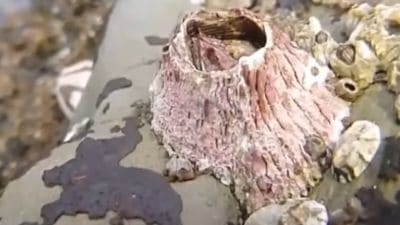
Non-motile adults have a calcareous (calcium carbonate) shell with several plates that enclose the body, protect the internal soft parts, and create an opening.
The feathery feeding appendages (modified legs) extend outward from the shell opening to capture plankton and detritus drifting in the water.
 How Do Barnacles Attach to Things in the Ocean?
Attachment takes place after they secrete a strong, protein-based, cement-like substance, from their antennae.
It's known as "barnacle cement" and it firmly glues the head onto a solid surface - and it stays in that position for life.
In fact, it is one of the strongest natural adhesives known.
What Do Barnacles Eat?
Barnacles are typical of most filter feeders (sometimes called suspension feeders), which means they capture and consume tiny organic particles that are suspended in the water.
For the most part, they will eat plankton (a combination of phytoplankton and zooplankton), decaying plants and animal material (known as detritus), and any specks of microscopic algae (microalgae) that may be floating in the water.
The feeding mechanism in rock barnacles occurs via special feathery nets (called cirri). While submerged, such as at high tide, they open up their hard calcium plates and extend food-gathering cirri from the operculum (a type of 'hinged door' that moves from open to closed).
These feathery appendages are able to create small currents of water, which allows them to sweep and capture any available food particles, before brushing them to the mouth for ingestion.
Barnacle Facts: Low tide often means some sea barnacle species will be exposed to air. If this happens, they close the plates (scutum and tergum) to prevent excessive desiccation (drying out) and they will cease feeding until the incoming tide covers them with water.
Types of Barnacles Species
Acorn Barnacle (Balanus glandula)
The common acorn barnacle (Balanus glandula) is also known as the North American acorn barnacle, one of the well-studied intertidal crustaceans.
They are native to rocky intertidal zones in the Pacific coast of North America, ranging from Alaska in the north and Baja California in the south, such as Bahía de San Quintín. They rank among some of the most abundant and ecologically dominant of all types of barnacles.
Acorn barnacles are commonly found on rocky substrates, usually attaching themselves to rocks, mollusk shells, pier pilings, and boat hulls.
Morphology and Feeding Habits
Most of the acorn barnacle species are small with a conical shell, generally between five (5) and twenty (20) millimetres in diameter. The shell is made of calcareous plates that form a volcano-like structure.
Even though the shell colour is usually white or gray, they often appear as weathered or eroded by strong waves. But, the opercular plates seal the opening when they're exposed to air to reduce desiccation (water loss).
Balanus glandula are sessile filter feeders that use modified appendages (called cirri) to capture planktonic organisms and detritus that drift in the water column.
The ecological role of common acorn barnacles should not be underestimated. Apart from being one of the foundation species in many rocky intertidal ecosystems, they also contribute to habitat complexity in many microhabitats for small invertebrates and algae.
Furthermore, they serve as prey for Pisaster (a genus of Pacific sea stars), whelks, and some shorebirds, such as black turnstones and surfbirds.
Giant Acorn Barnacle (Balanus nubilus)
Goose Barnacle (Lepas anatifera)
Little Gray Barnacle (Chthamalus dalli)
Picoroco (Austromegabalanus psittacus)
Pink Acorn Barnacle (Megabalanus rosa)
Polished Rock Barnacle (Tetraclita squamosa)
Rock Barnacle (Semibalanus balanoides)
Striped Barnacle (Amphibalanus amphitrite)
Titan Acorn Barnacle (Megabalanus tintinnabulum)
Turtle Barnacle (Chelonibia testudinaria)
Whale Barnacle (Coronula diadema)
How Do Barnacles Reproduce?
The reproductive strategies in barnacles is somewhat unusual for an animal that lives fixed in one place. Most of the species are hermaphrodites, so each individual has the male and female reproductive organ.
However, they reproduce asexually through cross-fertilisation with other barnacles that are close by - rather than self-fertilising.
Fertile adults are immobile (sessile) and unable to move to find a mating partner. But, their extremely long and flexible penis (around 8 times the body length) is considered as one of the longest in the animal kingdom.
They extend this organ to nearby individuals and transfer sperm into the mantle cavity for internal fertilisation.
But wait - there's more:
After the eggs have finished brooding inside the shell, they will hatch and become free-swimming larvae that drift in the open water (known as the nauplius stage).
Several molts later, the larvae will have grown enough to complete the cypris stage, where they use chemical cues to find a suitable substrate to settle and metamorphose into the adult form. Thus, they lose their swimming ability and develop the calcareous shell.
Barnacle Predators and Threats
Barnacle predation occurs through a range of natural predators and environmental threats, including biological and physical.
For example, some marine animals can scrape them away from hard surfaces, especially carnivorous snails, shore crabs, whelks, sea stars (starfish), and seabirds (particularly gulls at low tide).
Some marine fish with strong jaws, such as blennies and wrasses also eat barnacles by pecking them off the rocks.
Physical and Environmental Threats
- Desiccation (dryness): The risk of dehydration for intertidal barnacles increases at low tide, even though they can close their calcium plates to retain some moisture.
- Extreme fluctuations in water temperatures can be fatal for exposed barnacles.
- Strong wave action or shifting sand and rocks can cause physical damage to barnacles habitat - or dislodge them from their normal fixing point.
- Ocean pollution, such as oil spills and toxic chemicals impacts barnacle larvae and interferes with normal shell formation.
- Barnacles on rocks sometimes need to compete with other marine species, especially mussels and limpets, for available habitats on hard surfaces.
Human-Induced Threats
- Antifouling coatings and toxic paints used to prevent barnacle attachment on ships and boats tends to reduce their populations near harbours.
- Even small fluctuations in ocean temperature and acidity can have a detrimental effect on larval survival, reproductive rates, and shell strength.
Interesting Fact: The International Union for Conservation of Nature (IUCN) does not see any specific risk for the population status of barnacles (arthropods).
Related Information and Help Guides
- Sea Shrimp Facts and Species Information with Examples
- Crab Species Fun Facts and Information with Pictures
- Ecological Role of Copepods and Krill in Marine Environments
Note: The short video [2:45 minutes] presented by 'Deep Marine Scenes' contains even more barnacle facts with some amazing footage of acorn barnacles (Balanomorpha).